
If you are expanding into metal engraving, jewelry customization, or gunsmithing, upgrading to a galvo fiber laser is the single best investment you can make. Fiber lasers operate at a 1,064 nm wavelength—the exact optical frequency where metals absorb light energy rather than reflecting it away.
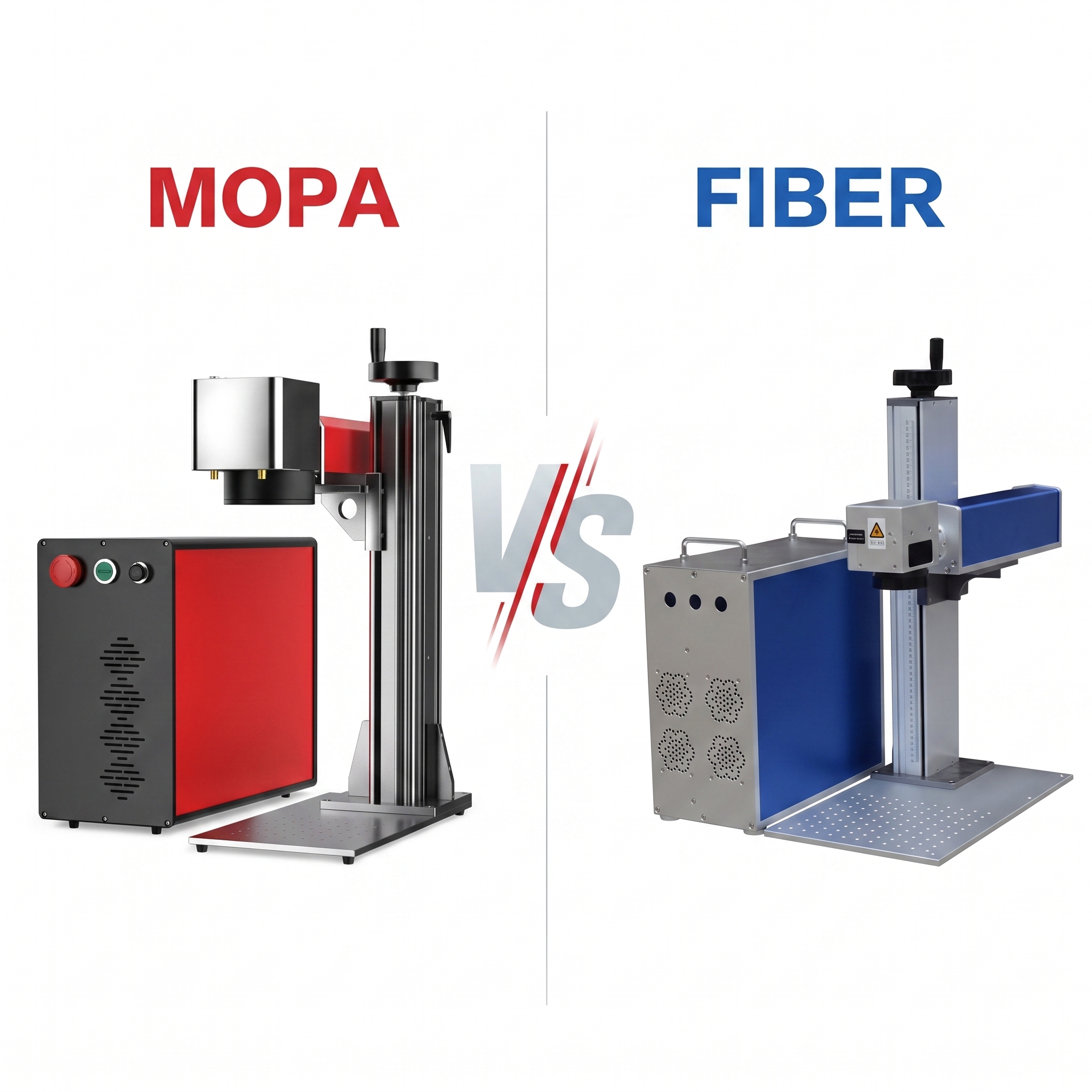
When shopping for desktop fiber machines from brands like OMTech, Cloudray, or Monport, you will immediately hit a crucial fork in the road: MOPA (Master Oscillator Power Amplifier) vs. Q-Switched (Standard Fiber).
A MOPA laser costs roughly 25% to 50% more than a standard Q-switched unit of identical wattage. Is the extra investment worth it for your business, or will a standard Q-switched unit handle everything you need?
Let’s break down the technical differences, material capabilities, and ROI realities so you choose the right machine the first time.

The Quick Answer: Key Differences at a Glance
The Core Difference: A Q-Switched fiber laser operates with a fixed, unchangeable pulse duration (typically 100–120 nanoseconds), limiting its control over thermal build-up. A MOPA fiber laser allows you to independently adjust pulse width (from 2 ns to 500 ns) alongside frequency, providing precise heat management for vivid color annealing on stainless steel, dark engraving on anodized aluminum without surface ablation, and damage-free marking on delicate foils.
| Feature / Spec | Standard Q-Switched (e.g., Raycus / Max) | MOPA Fiber Laser (e.g., JPT M7 / M8) |
| Pulse Width Control | Fixed (~100–140 ns) | Variable (2 ns to 500 ns) |
| Frequency Range | Narrow (20 kHz – 80 kHz) | Wide (1 kHz – 4,000 kHz / 4 MHz) |
| Stainless Steel Color Annealing | Inconsistent / Muted Straws & Blues | True Spectrum (Dozens of vibrant colors) |
| Black Mark on Anodized Aluminum | Destroys the oxide layer (white etch) | Deep, rich black without burning/pitting |
| Deep Engraving & Coin Carving | Excellent, aggressive removal | Excellent, smooth bottom finishes |
| Thin Metal Foil Cutting | High risk of curling, burring, and warping | Minimal heat-affected zone (HAZ), clean edges |
| Typical Price (30W–60W) | $1,900 – $3,200 | $2,800 – $5,400 |
1. Pulse Duration: Why Nanoseconds Matter
To understand why MOPA lasers cost more, you have to understand how fiber lasers interact with metal.
Both machine types fire light in rapid micro-bursts called pulses. The duration of each pulse is measured in nanoseconds (ns)—billionths of a second.
The Q-Switched Limitation
On a standard Q-switched machine (commonly powered by Raycus or Max Photonics sources), every laser burst lasts roughly 100 to 120 nanoseconds. You can change how many pulses fire per second (Frequency / kHz) and the speed of the galvo mirrors, but you cannot control how long each burst dwells on the metal.
Because the pulse is relatively long, each burst injects significant heat into the surrounding material. This creates a larger Heat-Affected Zone (HAZ).
The MOPA Advantage
On a MOPA laser (most notably using JPT M7 or M8 sources), the optical oscillator and amplifier are decoupled. This allows you to dial in the pulse width anywhere from 2 ns up to 500 ns:
- Ultra-Short Pulses (2–20 ns): The laser vaporizes or heats the target surface so rapidly that heat has no time to bleed into the surrounding workpiece. You can mark ultra-thin foils, delicate electronics, and heat-sensitive coatings without warping.
- Long Pulses (200–500 ns): Dwell time increases, delivering the sustained heat energy required for high-volume material removal and deep bas-relief coin carving.
2. Color Marking on Stainless Steel and Titanium
The ability to create vibrant colors is the #1 reason crafters and small business owners consider a MOPA laser.
How Color Marking Works
Fiber lasers do not use pigments, inks, or chemicals to color metal. Instead, the laser heats the surface of stainless steel (grades 304 and 316) or Grade 5 titanium, causing a microscopic, transparent oxide film to grow over the surface.
When ambient light strikes this transparent oxide layer, light rays bounce off both the top of the oxide film and the metal underneath. The two waves interfere with each other, canceling out certain wavelengths and amplifying others—a phenomenon known as thin-film optical interference.
The specific color you see (yellow, magenta, cyan, cobalt blue, gold) depends entirely on the thickness of that oxide layer, measured in single nanometers.
Why MOPA Dominates Color
- With Q-Switched: Because the pulse width is locked, hitting the exact nanometer thickness needed for true colors is nearly impossible. You can produce muted shades of brown, faint straw-yellow, and irregular slate-blue, but the heat bleed causes uneven oxidation across the design.
- With MOPA: By tuning pulse width (typically 4–20 ns) and frequency (300–800 kHz), you gain precise micro-control over heat input. You can reliably produce clean color palettes across stainless tumblers, business cards, knife blades, and watch dials.
3. Black Marking on Anodized Aluminum
For phone cases, serial number plates, and tactical gear, engraving anodized aluminum is an everyday commercial task.
- Standard Q-Switched: The fixed pulse aggressively burns through the dyed anodic coating and micro-fractures the underlying aluminum, leaving a crisp frosted white or silver mark. If your design calls for high contrast on black anodized metal, white looks great.
- MOPA: By dropping the pulse width down to 2–6 ns and ramping the frequency past 500 kHz, a MOPA laser modifies the microscopic surface roughness of the anodic layer without shattering it. The result is a velvety, deep matte black mark that leaves the protective anodized seal smooth and intact to the touch.
4. Deep Engraving and Coin Carving: Is MOPA Better?
If your primary goal is deep metal carving—such as custom brass challenge coins, firearm slides, leather embossing stamps, or sterling silver jewelry casting blanks—a standard Q-switched laser holds its own remarkably well.
Deep engraving requires brute-force material removal. A 50W or 60W standard Raycus Q-switched fiber laser can blast through brass, copper, and carbon steel rapidly.
Where MOPA provides an edge in deep engraving is in the finishing pass:
- You use high-power, long pulses to hog out 90% of the metal quickly.
- You switch your final LightBurn layer to a short pulse width (10–30 ns) with a high hatch density to polish the floor of the engraving, eliminating the gritty “stippled” texture left by standard fiber passes.
If your budget is tight and deep metal removal is 90% of your business, a higher-wattage Q-switched machine (e.g., 50W Raycus) will consistently outperform a lower-wattage MOPA (e.g., 30W MOPA) on pure carve speed.
5. Cost Comparison & Return on Investment
| Machine Class | Price Range | Best Suited For |
| 30W Standard Q-Switched | $1,800 – $2,300 | Beginners, daily serial tagging, white-on-black aluminum marking, knife blade etching, shallow metal marking. |
| 50W–60W Standard Q-Switched | $2,600 – $3,400 | High-speed production, deep coin engraving, brass stamps, gun slide stippling on a budget. |
| 30W MOPA (JPT M7) | $2,700 – $3,400 | Art pieces, jewelry makers, color marking on small stainless items, low-volume high-detail work. |
| 60W MOPA (JPT M7/M8) | $4,200 – $5,500 | The “Do-Everything” commercial workhorse. Deep engraving speed combined with full color palette capability and high-frequency black marking. |
Pro Tip: Fiber laser purchases are significant investments. If purchasing an OMTech Galvo unit, remember to apply verified coupon code
ME5OFFat checkout to shave 5% ($150 to $275+) off your order.
Final Recommendation: Which One Should You Buy?
Buy a Standard Q-Switched Fiber Laser If:
- Your primary goals are serial numbers, gun parts/slides, EDC gear, knife blades, and clean white marking on anodized aluminum.
- You focus heavily on deep 2.5D coin carving and want the maximum wattage per dollar (e.g., opting for a 50W Raycus over a 30W MOPA).
- You do not plan to sell colored artwork or dark-marked anodized products.
Buy a MOPA Fiber Laser If:
- You want to sell full-color stainless steel tumblers, personalized jewelry, titanium EDC gear, and art prints.
- You need deep black marking on anodized aluminum without stripping the protective oxide layer.
- You work with ultra-thin metals (brass foils, guitar picks, precious metal sheet) where minimizing heat distortion and warping is essential.
- You run an engraving service and want zero technical limits when a client asks, “Can you engrave this in color?”
Frequently Asked Questions
Can a Q-switched fiber laser do color marking at all?
Under very narrow conditions, yes, but it is impractical for commercial production. You can sometimes hit inconsistent straw yellows and dull slate blues on 304 stainless steel by running high line densities and slowing the speed down to crawl speeds. However, slight variations in room temperature, metal alloy batches, or focal distance will ruin the repeat accuracy. True, repeatable color palettes require the pulse control of a MOPA.
Which laser source brand is best for MOPA?
The gold standard for desktop MOPA fiber lasers is JPT (specifically the JPT M7 or JPT M8 series). JPT sources offer wide frequency bandwidth (up to 4,000 kHz) and reliable pulse adjustment. For Q-switched units, Raycus and Max Photonics are the industry standards for durability and raw cutting performance.
Can both MOPA and Q-switched lasers cut through metal?
Yes, but fiber lasers cut thin metal by making multiple passes to vaporize layers rather than blowing molten metal with an assist gas like heavy industrial flatbed lasers. A 50W or 60W unit of either type can cleanly cut 0.5 mm to 1.0 mm silver, brass, and gold sheet using multiple passes in LightBurn, making them popular for jewelers cutting custom pendants.

Leave a Reply